
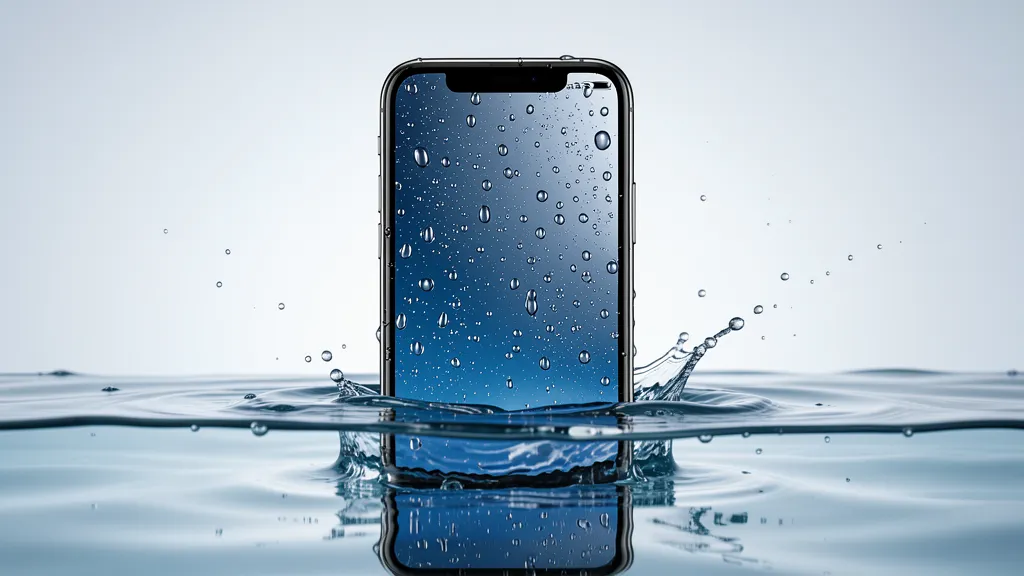
It is a Saturday afternoon at Sentosa. You are taking photos in the pool with your new iPhone 15 Pro Max. It’s rated IP68, so you dunk it underwater for a cool slow-motion shot. Five minutes later, the screen flickers. Ten minutes later, the Apple logo flashes on a loop. An hour later, the phone is dead.
We see this scenario at our Bugis and Marine Parade (Parkway Parade) branches almost every single day. The customer is always shocked: “But Apple’s website says it can handle 6 meters for 30 minutes! Why did it die in a 1-meter pool?”
1. De-Coding the Jargon: What Does IP68 Actually Mean?
To understand why your phone failed, you need to understand the IEC 60529 standard. “IP” stands for Ingress Protection. It consists of two digits (e.g., IP68):
- The First Digit (Dust): Score 6
This means the phone is “Dust Tight.” In a vacuum chamber test, no dust enters the device. Modern phones are excellent at this. - The Second Digit (Water): Score 8
This usually means immersion beyond 1 meter for 30 minutes. However, IP68 (Deep Water) does NOT automatically mean it passed IP66 (High-Pressure Jets). A “waterproof” phone can survive a toilet drop but die instantly if hit by a shower jet.
2. The “Laboratory Lie”: Why Real World Water is Different
When Samsung or Apple tests a phone, they do it in static, distilled, fresh water at room temperature. Here is why Singaporean life destroys these conditions:
A. The Pressure Differential (Thermal Shock)
Have you ever taken your phone from a cold air-conditioned office out into the hot, humid Singapore afternoon? Or jumped into a cold pool with a hot phone?
Physics Check: When a hot phone hits cold water, the air inside contracts rapidly, creating a vacuum effect. This literally sucks water through the rubber seals. IP ratings do not account for this suction force.
B. The “Soap” Factor (Surface Tension)
Water has surface tension—it likes to stick to itself. The mesh grills on your speakers rely on this to stop water.
Soap is a surfactant. It lowers surface tension. If you wash your phone with soap, the water becomes chemically “thinner” and slips right through the waterproof mesh. Never wash your phone with soap.
C. The Chemistry of Corrosion (Salt & Chlorine)
- Chlorine: A harsh oxidizer that attacks rubber gaskets, making them brittle and cracked.
- Salt Water: The ultimate killer. It is highly conductive. Even one drop bridges connections on the motherboard, and when it dries, salt crystals continue to eat the copper circuits like cancer.
3. The “Time Bomb”: Why Age Matters
If you bought your phone yesterday, it is likely water-resistant. If you bought it 18 months ago, it is likely NOT.
Modern phones are held together by adhesive. In Singapore’s high humidity and heat, this glue softens over time. Every drop, every charge cycle (heat expansion), weakens the seal.
4. Emergency Protocol: DO’s and DON’Ts
🚫 THE “DON’T” LIST
- NO RICE: It creates dust that turns into paste inside your phone. It does not suck water from the motherboard.
- NO HAIR DRYER: Heat melts the adhesives and damages the LCD.
- NO CHARGING: Sending electricity through wet circuits is instant death for the phone.
✅ THE “DO” LIST
- TURN IT OFF: Immediately. Hard reset if you have to.
- REMOVE SIM: This opens a vent for air to circulate.
- GET TO A TECH: You have a “Golden Window” of 24-48 hours before permanent corrosion sets in.
5. How We Fix It: The “Chemical Wash” Process
At BreakFixNow, we don’t just wipe your phone. We perform a forensic-level cleaning known as a Chemical Wash. Here is exactly what you are paying for:
- Full Disassembly: We strip the phone down to the bare motherboard.
- Ultrasonic Bath: We use an industrial cleaner with 99.9% Isopropyl Alcohol. High-frequency sound waves blast away corrosion from underneath the chips where brushes can’t reach.
- Micro-Soldering Check: We test voltage lines and replace shorted capacitors.
Success Rate:
- Within 24 hours: 90% Success Rate
- After 1 week: 50% Success Rate
STOP READING AND ACT NOW.
Is your phone wet right now? Every second you wait, corrosion is eating the motherboard. The difference between a working phone and a paperweight is Time.
⚡ 90% Success Rate if brought in within 24 hours
BOOK FREE WATER DAMAGE CHECK >
📍 Locations: Bugis, Marine Parade (Parkway Parade), Yishun, Bukit Panjang | 📞 WhatsApp: +65 9788 0587
Frequently Asked Questions
Does putting a wet phone in rice actually work?
No, rice is a myth. While rice can absorb some surface moisture, it cannot draw water out from inside a sealed device like an iPhone. Worse, rice starch and dust can enter the charging port and mix with water to create a cement-like paste that speeds up corrosion.
How much does water damage repair cost in Singapore?
Water damage repair typically involves a “Chemical Wash” fee ranging from $50 to $80. If parts (like the screen or battery) are damaged, those are additional. However, BreakFixNow offers a “No Fix, No Pay” policy—if the phone cannot be revived, you pay nothing.
Will Apple/Samsung fix my water damaged phone under warranty?
No. Even though phones are marketed as water-resistant, standard manufacturer warranties explicitly exclude liquid damage. They use internal “Liquid Contact Indicators” (red stickers) to verify if water has entered, which instantly voids your warranty coverage.
Can I retrieve data from a dead water-damaged phone?
Yes, in most cases data is recoverable. Even if the screen doesn’t turn on, professional microsoldering can often temporarily restore power to the motherboard to extract photos and files. Unlike official service centers which wipe data, third-party repair shops prioritize data preservation.
Is the iPhone 15 waterproof in salt water?
No. The IP68 rating is tested in fresh water only. Salt water is highly corrosive and conductive. If an iPhone is exposed to salt water, the salt can crystallize on the motherboard and charging pins, causing permanent electrical shorts even after the phone dries.