
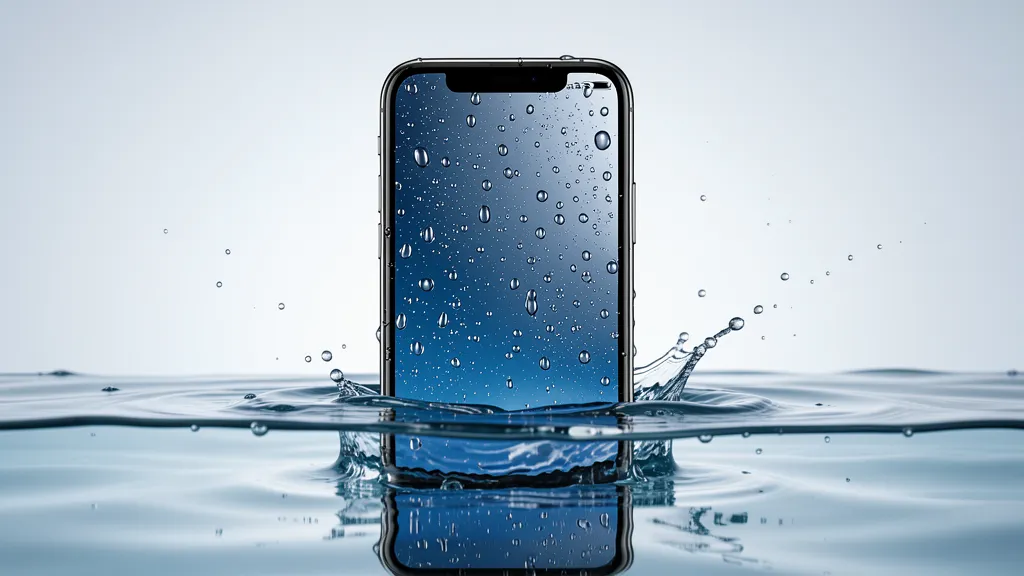
Quick answer: No. “Water-resistant” phones are not waterproof. IP68 is tested in still, fresh water in a lab. Pools, the sea, soap, jets of water, temperature changes and ageing seals can all let water in, and liquid damage is not covered by warranty. If your phone gets wet: switch it off, don’t charge it, skip the rice, and get it cleaned within 24–48 hours. Updated November 2026.
It’s a Saturday afternoon at Sentosa. You’re taking photos in the pool with your new iPhone 15 Pro Max. It’s rated IP68, so you dunk it underwater for a slow-motion shot. Five minutes later, the screen flickers. Ten minutes later, the Apple logo flashes on a loop. An hour later, the phone is dead.
We see cases like this regularly. The customer is always surprised: “But Apple’s website says it can handle 6 metres for 30 minutes! Why did it die in a 1-metre pool?”
The harsh truth: calling a phone “waterproof” gives a false sense of security. This guide explains what IP ratings really mean, why real-world water is different, and why you should never get your phone wet on purpose.
1. What Does IP68 Actually Mean?
IP ratings come from the IEC 60529 standard. “IP” stands for Ingress Protection, followed by two digits:
| Digit | Meaning | What it does and doesn’t cover |
|---|---|---|
| First digit: 6 | Dust-tight | No dust gets in during the test. Modern phones are very good at this. |
| Second digit: 8 | Immersion beyond 1 metre | Depth and time set by the maker (e.g. 6m for 30 minutes). It does not mean the phone passed high-pressure jet tests (IPX5/IPX6). |
So a phone that survives a drop in the sink can still let water in from a shower jet or a wave.
2. Why Real-World Water Is Different
Manufacturers test in still, fresh water at room temperature. Everyday life in Singapore is different:
A. Temperature changes
Taking a hot phone into a cold pool (or a cold phone from an air-conditioned room into the heat) makes the air inside contract or expand. That pressure change can pull water past the seals. IP tests don’t account for it.
B. Soap and shampoo
The mesh over speakers and microphones relies on water’s surface tension to keep it out. Soap lowers surface tension, so soapy water slips through much more easily. Never wash your phone with soap.
C. Chlorine and salt
- Chlorine degrades rubber gaskets over time.
- Salt water is highly conductive and corrosive. Even after it dries, salt crystals keep corroding the board.
3. Why Age Matters
A brand-new phone is at its most water-resistant. After a year or two, it’s much less so. Phones are sealed with adhesive, and heat, humidity, drops and charging cycles all weaken that seal over time.
Tip: if your screen has ever been replaced without proper re-sealing, assume the phone has little or no water protection left. At BreakFixNow we fit new adhesive seals whenever we open a phone.
4. Emergency Protocol: Do’s and Don’ts
| Don’t | Do |
|---|---|
| Put it in rice — it doesn’t draw water out and leaves starch dust in the ports | Turn it off immediately (force it off if needed) |
| Use a hairdryer — heat damages adhesives and the display | Remove the SIM tray to help air circulate |
| Charge it — power through wet circuits causes shorts | Get it to a technician within 24–48 hours, before corrosion sets in |
Full steps: water-damaged phone: 8 steps to save it.
5. How We Fix It: The Chemical Wash
- Full disassembly down to the bare board.
- Ultrasonic cleaning with high-purity isopropyl alcohol, which reaches corrosion under chips where brushes can’t.
- Board-level checks: we test the power lines and replace shorted components.
The sooner the phone comes in, the better the chances — a phone cleaned within a day has a far better outlook than one left for a week. And with our No Fix No Pay guarantee, you don’t pay if we can’t fix it.
Frequently Asked Questions
Does putting a wet phone in rice actually work?
No. Rice can absorb some surface moisture, but it can’t draw water out from inside a sealed phone. Rice dust can also get into the charging port and mix with water, speeding up corrosion.
How much does water damage repair cost in Singapore?
A chemical wash at BreakFixNow costs about S$48–88. If parts such as the screen or battery are damaged, those are quoted separately after diagnosis.
Will Apple or Samsung fix my water-damaged phone under warranty?
Usually not. Even though phones are marketed as water-resistant, standard warranties exclude liquid damage, and the manufacturer checks the liquid contact indicators inside.
Can I retrieve data from a dead water-damaged phone?
Often, yes. Even if the screen doesn’t turn on, board-level repair can sometimes restore enough power to get photos and files off the phone.
Is the iPhone 15 waterproof in salt water?
No. IP68 is tested in fresh water only. Salt water is highly corrosive, and salt left on the board and charging pins can cause permanent shorts even after the phone dries.
Is your phone wet right now? Every hour counts. Bring it in for a free water damage check — chemical wash from S$48, No Fix No Pay.
Waterproof or Not?
Board-level checks
No Fix No PayFrom S$48